
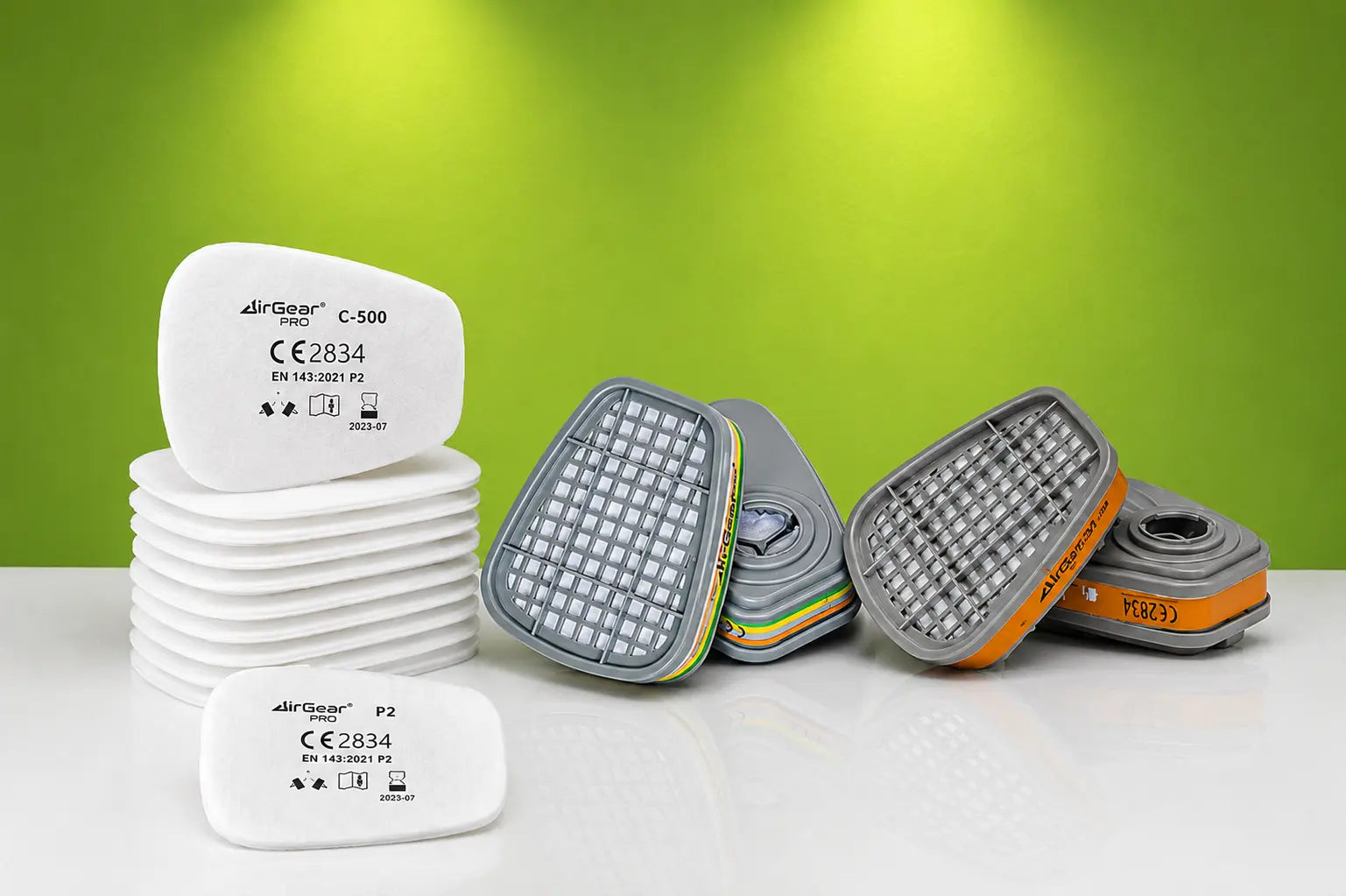
Comprehensive Guide to Choosing Respirator Filters
Understanding the critical role of respirator filters in protecting against hazardous substances is essential for ensuring workplace safety. This guide delves into different types of respirator filters, their applications, and standards, providing you with the knowledge to select the right filter based on your specific needs.
FILTER TYPES AND STANDARDS: Respirator filters are categorized based on the protection they offer against different hazards, including particles, gases, and vapors. European standards have set the criteria for these filters:
| EN 14387 | Focuses on anti-gas and combined filters |
| EN 143 | Targets particle filters, introducing classifications like P1,P2, and P3 for dust resistance and reusability. |
| EN 372 SX | Specializes in anti-gas filters against specific substance combinations, extending the coverage of EN 14387. |
| EN 149 | Defines specifications for disposable masks, emphasizing single-use protection |
AEROSOL FILTERS: WHEN AND HOW
| Aerosol filters are crucial for environments with suspended solid or liquid particles. Their design aims to protect against these particles with negligible falling speeds. |  |
Application Scenarios: Aerosol filters are utilized when facing risks from solid particles and liquid aerosols, offering protection in diverse settings from construction sites to chemical handling facilities.
Identification Tips: Disposable Masks-Marked with “FFP” followed by a class (P1, P2, P3), directly on the mask. Filter Cartridges- Feature a white band around the cartridge, indicating the filter class.
Efficiency Classes
| Class P1 filters (low efficiency) | Stop at least 80% of this aerosol (i.e., penetration of less than 20%) |
| Class P2 filters (medium efficiency) | Stop at least 94% of this aerosol (i.e., penetration of less than 6%) |
| Class P3 filters (high efficiency) | Stop at least 99.95% of this aerosol (i.e., penetration of less than 0.05%) |
How to choose the efficiency class of an anti-aerosol filter?
| P1 | Annoying dusts, non-toxic fibrogenic dusts |
| P2 | Toxic dust (wood, polyester resin, etc.), metal fumes (welding fumes), Oil Mist |
| P3 | Very toxic dust (asbestos, arsenic, cadmium, etc.) lead, welding fumes, Oil Mist |
Gas and Vapor Filters: Selection and Recognition
| Protection against gases and vapors requires filters designed for specific substances, identifiable by unique markings. |  |
Recognizing Gas Filters: Each filter type is marked with a letter and color band, indicating its protective capacity against certain gases or vapor families.
| Type | Couleur | Domaine d'utilisation |
|---|---|---|
| A | Brown | Gaz et vapeurs organiques avec un point d'ébullition supérieur à 65°C |
| B | Gray | Gaz et vapeurs inorganiques (sauf le monoxyde de carbone CO) certains fabricants proposent des filtres spécifiques contre le monoxyde de carbone (CO) |
| E | Yellow | Dioxyde de soufre (SO2) et autres gaz et vapeurs acides |
| K | Green | Ammoniac et dérivés aminés organiques |
| HgP3 | Red + white | Vapeurs de mercure |
| NOP3 | Blue + white | Oxydes d'azote |
| AX | Brown | Composés organiques à bas point d'ébullition (65°C) |
| SX | Purple | Composés spécifiques désignés par le fabricant |
How to choose the efficiency class of a gas filter?: There are three classes of gas filters based on their trapping capacity
| Classe 1 | The lowest capacity (cake) |
| Classe 2 | Average capacity (cartridge) |
| Classe 3 | Largest capacity (can) |
How to read the marking on a gas filter? The filter is marked according to the type of gas and the efficiency class: A1, A2, A3, AB2 (or A2B2)… The following combinations can be found:
| AB1 (also A1B1) (or 2 or 3) | Brown + gray | Mixed filter against organic gases and vapors and class 1 (or 2 or 3) inorganic gases and vapors |
| BK1 (also B1K1) (or 2 or 3) | Gray + green | Mixed filter against inorganic gases and vapors and against ammonia and class 1 (or 2 or 3) organic amine derivatives |
| AE1 (also A1E1) (or 2 or 3) | Brown + yellow | Mixed filter against organic gases and vapors and sulfur dioxide and acid vapors |
| ABEK1 (also A1B1E1K1) (or 2 or 3) | Brown + gray + yellow + green | Mixed filter against organic, inorganic gases and vapors, sulfur dioxide, acids and against ammonia and class 1 (or 2 or 3) amine derivatives |
COMBINED PROTECTION: For environments where protection against both aerosols and gases/vapors is necessary, combined filters offer a solution. These filters integrate multiple protective layers, catering to diverse workplace hazards. Many other combinations are possible depending on the suppliers.
| AXP1 (or 2 or 3) | Brown + white | Combined filter against low boiling point organic gases and vapors and against class 1 (or 2 or 3) aerosols |
| AB1 (or 2 or 3) (also A1B1 or 2 or 3) P1 (or 2 or 3) | Brown + gray + white | Combined filter against class 1 (or 2 or 3) organic and inorganic gases and vapors and against class 1 (or 2 or 3) aerosols |
Some examples of areas of application of gas filters
| Type A filtration | Protection against organic vapors with a boiling point above 65° C (solvents and hydrocarbons): Acetates, Acids (acetic, acrylic), Acrylate (methyl ethyl), Alcohols, Benzene, Butanol, Butyl Glycol, Cresols, Dichloro (-ethane, – benzene, -toluene), Aromatic essences Ethanol, dichloroethyl, Ethyl glycol, Isopropanol, Kerosene, Methyls, Perchlorethylene, Phenols, (AB), (AK), Styrene, Turpentine, Trichlorethylene, Trichloroethane, Toluene, White spirit , Xylenes |
| AX type filtration | Protection against organic vapors with a boiling point below 65° C: Methyl acetate, Acetone, Bromoethane, Butane, Chloroethane, Chloroform, Vinyl chloride, Dichloroethane, Dichloroethylene, Dichloromethane, Diethylamine, Dimethyl ether, Formate ethyl, Freons, Methanol, Methylbutane, Trichloromethane |
| Type B filtration | Protection against inorganic gases and vapors : Acids (hydrogen cyanide, nitric, hydrogen sulfide), Aminopropane, Bromine, Hydrogen bromide, Chlorine ( ), Cyanides, Chlorine dioxide, Fluorine, Formalin), Arsenic hydrogen, Isocyanates, Nitroglycerin, Sulfide carbon |
| Type E filtration | Protection against: Acids (hydrobromic, hydrochloric, hydrofluoric, formic), Sulfur dioxide, Sulfur dioxide, Hydrochloric gas |
| Type K filtration | Protection against ammonia and certain amine derivatives: Aziridine, Butylamine, Diethylamine, Diisopropylamine, Dimethylamine, Dimethylhydrazine, Ethylamine, Ethylene imine, Hydrazine, Isopropylamine, Methylamine |
MAKING THE RIGHT CHOICE: Selecting the appropriate respirator filter involves understanding the specific hazards of your work environment and referring to safety data sheets for guidance. Whether dealing with aerosols, gases, or a combination of both, the right filter can significantly impact your safety and health.
CONCLUSION: The choice of respirator filter plays a crucial role in workplace safety, protecting against a range of hazardous substances. By familiarizing yourself with the types of filters, their standards, and application scenarios, you can ensure complete respiratory protection in your professional environment. For those seeking proven and reliable options, AirGearPro respirator masks, such as the G-500 and G-750 models, are among the top choices for professionals. These masks, known for their effectiveness and comfort, come with replaceable filters, ensuring longevity and adaptability to various work environments. User safety being a priority, these products exemplify AirGearPro’s commitment to providing top-tier respiratory protection solutions.
For more insights, check out our other informative blogs: Understanding Respirator Masks and Occupational Health A Holistic Guide to Choosing the Right Respirator for Your Safety
Share:
Safety and health at work